


Managing water blind: the risk of non-digitalized systems
A continuous water supply is a fundamental requirement for any livestock operation. In geographically dispersed infrastructures managed manually, ensuring this supply can become a significant operational challenge.
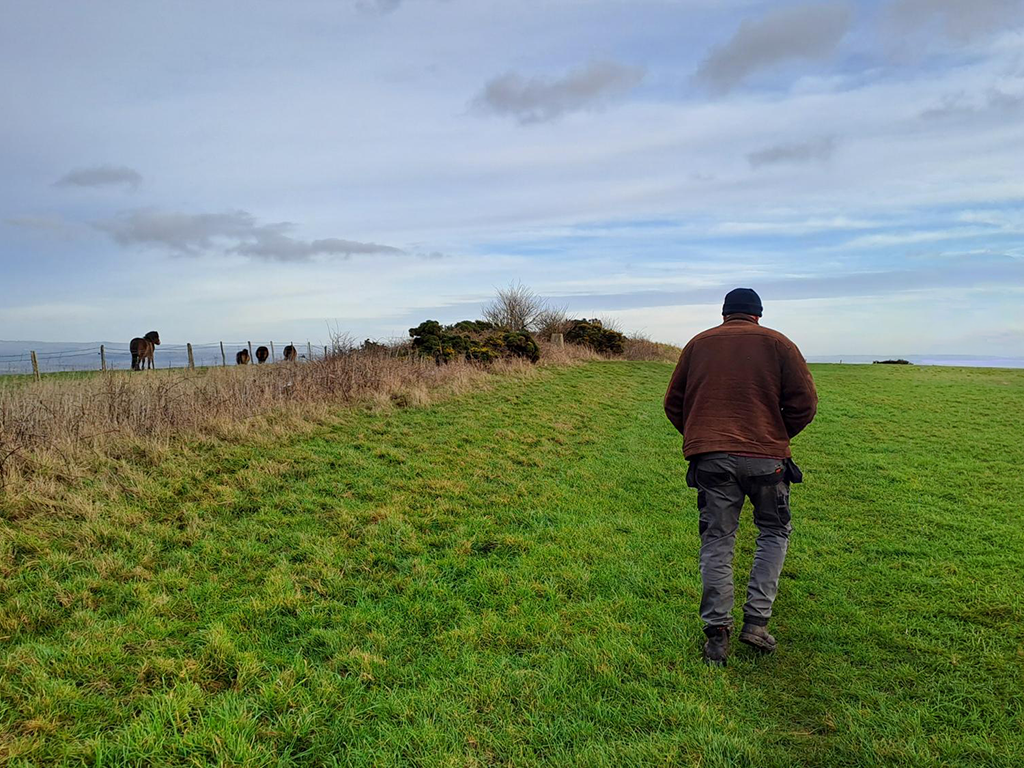
Located in the heart of South Downs National Park in southeast England, Church Farm is part of the Longbridge Estate ecosystem, a project that combines regenerative agriculture and livestock farming under the principles of circular economy, local production, and sustainable resource management.
The project also includes the Long Man Brewery initiative, founded in 2011 by third-generation farmer Duncan Ellis, with the aim of diversifying the farm’s activities and securing its long-term viability.
The barley used in the brewery is grown on the farm using regenerative practices such as no-till farming and cover cropping, with the goal of improving soil health and reducing environmental impact.
This approach extends across the wider estate: Longbridge promotes biodiversity projects, conservation grazing, and circular economy initiatives, integrating agricultural production, livestock farming, and business activity.
Water as a critical point
Southern England is experiencing shifts in climate patterns. The official body Met Office* indicates increasing variability in rainfall and more frequent summer drought episodes.
In areas such as the South Downs, where chalky soils dominate, low water retention makes water management especially critical.
In this context, water management is no longer just an operational matter, it becomes a key factor for farm resilience and continuity. In extensive livestock systems, any disruption in supply can directly impact animal welfare and may require urgent field interventions to locate and resolve issues.
At the same time, increasing climate variability demands more resilient infrastructure, capable of adapting quickly to changes in water demand and resource availability.
* https://www.metoffice.gov.uk/research/climate
The challenge
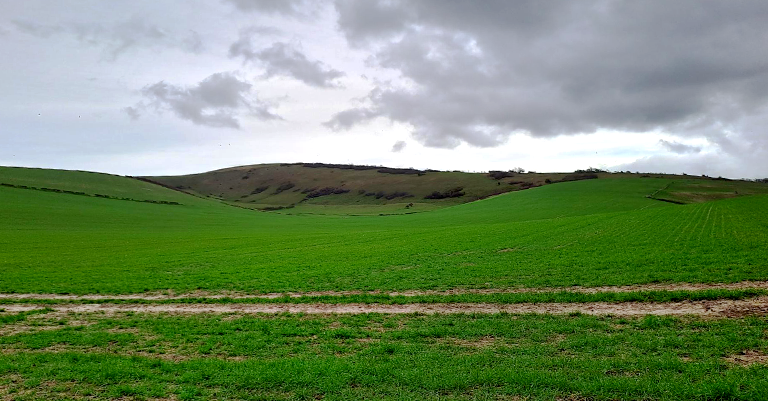
Water had to travel across a dispersed infrastructure set within a complex landscape, with system components separated by hills and woodland areas.
Until then, system performance relied heavily on manual checks and the ability to respond quickly to any incident.
For an operation committed to regenerative livestock farming and extensive grazing, this lack of visibility posed a risk that went beyond operational efficiency.
The system is based on:
- An elevated reservoir
- Gravity-fed distribution
- Water pumping
Without digitalization, this resulted in a lack of real-time visibility, dependence on manual operations, and increased risk to animal welfare in the event of any system failure.
Digitalising water beyond irrigation
The installation was carried out by our local partner WrootWater, a company specialized in water solutions for the agricultural sector with more than two decades of experience in the United Kingdom.
WrootWater has positioned itself as a comprehensive solutions provider, not only in irrigation systems, but also in complex hydraulic infrastructure that includes complementary technologies such as pumping, water treatment, filtration, weather stations, and environmental monitoring.
We share with WrootWater a technical approach focused on efficiency, so our collaboration with Spherag on this and other projects represents a natural evolution in its value proposition, integrating digital tools that enable the transition from traditional hydraulic systems to data-driven smart infrastructure.
In this case, their team opted to integrate Spherag’s technology in a context beyond conventional agricultural irrigation.
Technical installation overview
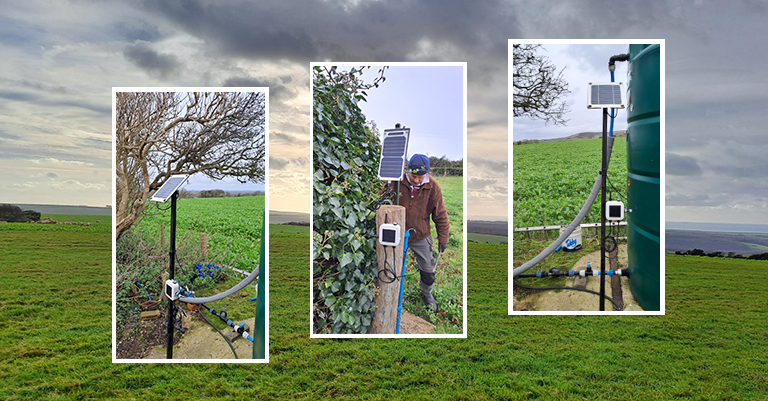
To achieve this, a network of IoT devices and sensores was deployed to monitor water consumption, control pump operation, and track reservoir levels in real time.
Rule-based automation
One of the main changes has been the shift from manual supervision to a system capable of automatically responding to the farm’s actual needs. This advancement allows the water system to move from being “managed” to becoming self-regulating.
This level of autonomy ensures service continuity while optimizing resource use:
- Proactive response: when reservoir levels drop, the system instantly detects the need for replenishment and activates the pumping process without human intervention.
- Operational efficiency: once the optimal level is reached, the system stops the process precisely, preventing overflows, minimizing energy consumption, and reducing equipment wear.
This is made possible through conditional programming. With this approach, logical rules are defined to link specific variables to executable actions. By setting these conditions, the infrastructure evolves from a passive system into an active tool capable of making real-time decisions, continuously adjusting its performance to meet changing environmental demands.
A technical challenge: terrain, distance and accessibility
One of the key aspects of the project is the physical complexity of the installation, as the infrastructure is spread across a fragmented landscape of hills and woodland.
In addition, the different system components are located separately and at significant distances from each other, the pump is positioned in a low-lying, vegetated area, while the reservoir sits at the top of a hill, from where water is distributed by gravity.
In this type of environment, many traditional solutions require civil works, cabling, or additional infrastructure that are not always feasible.
This is where Spherag’s architecture provides a clear advantage:
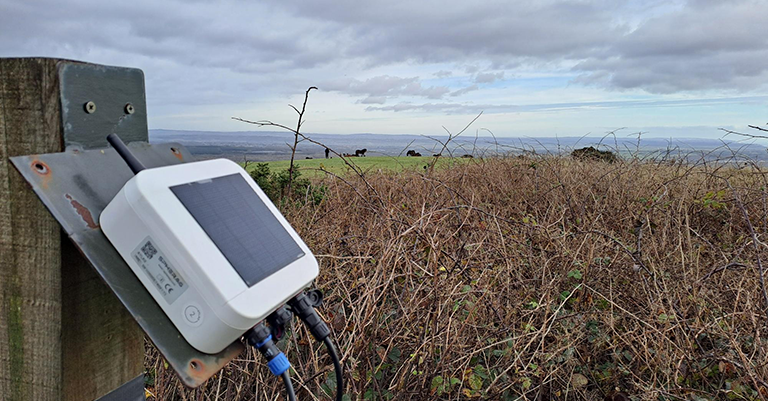
- Standalone solar-powered devices
- No wiring required
- Independent connectivity at each point
This enables deployment without modifying existing infrastructure or carrying out complex construction work.
Even in a country like the United Kingdom, where solar radiation is limited, the energy efficiency of Atlas IoT devices allows for fully autonomous operation.
This demonstrates that the solution is not only effective in ideal conditions, but also in demanding environments where factors such as energy availability or connectivity can constrain other technologies.
From manual work to intelligent control
For the farm team, this translates into:
- Remote pump control
- Real-time monitoring
- Process automation
- Elimination of unnecessary site visits
This represents a shift from reactive management to a proactive, autonomous system, ensuring continuous water supply.
A critical factor in extensive grazing systems used in conservation-focused projects such as Church Farm.
Technology adaptable to new contexts
This case highlights that water-related challenges go beyond irrigation and that digitalization can deliver value across a wide range of infrastructure types.
The combination of monitoring, infrastructure automation, and remote management makes it possible to adapt technology to different production contexts without altering its core architecture.
The experience of Longbridge Estate reflects an increasingly common reality in European agriculture, water management is no longer just about access to the resource, but about having infrastructure capable of adapting to changing conditions.
In a context shaped by climate uncertainty, the ability to anticipate issues, automate critical processes, and ensure animal welfare becomes a key factor in farm resilience.
Check out the case study in Farmers Weekly as well.