


Starting point: Offline controler with fixed irrigation times or adjustment to changing conditions
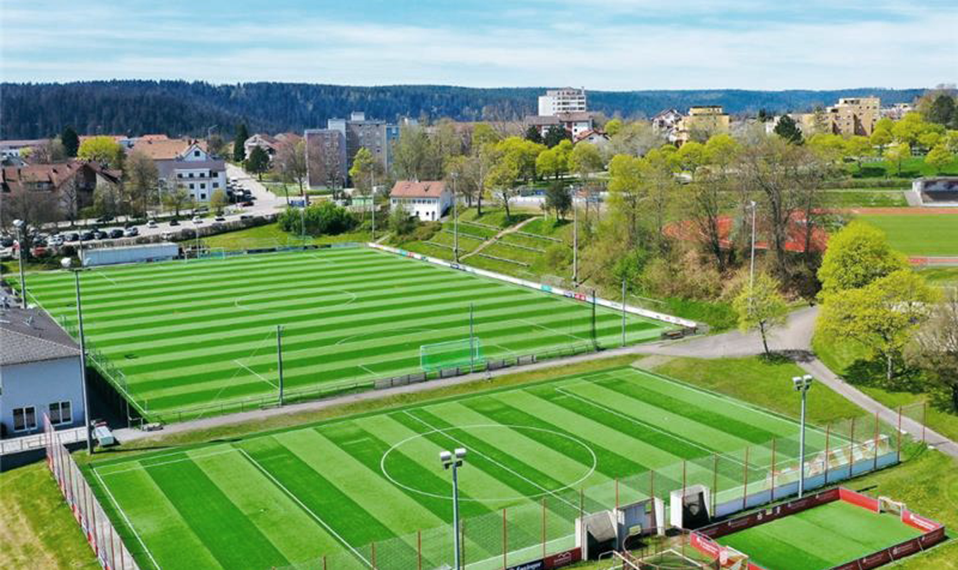
The municipal football field in Illingen, Baden-Württemberg (Germany), operated with a sprinkler irrigation system managed through a local controller. This meant that any adjustment had to be made on-site, from a computer, directly impacting daily operations.
In practice, the maintenance manager had to spend time everyday programming and monitoring irrigation. According to project data, this task could take up to one hour per day.
Apart from the time involved, the biggest challenge was the lack of precision:
- Irrigation was carried out according to fixed schedules, without taking actual soil moisture conditions into account
- Over- or under-irrigation was a frequent occurrence
- The football field did not always offer optimal playing conditions
- Overseeding and reseeding were challenging
In sports turf, this is a critical factor. Uniformity, surface firmness, and playability depend directly on proper water management. This is further influenced by the variable climate of southern Germany, where wetter periods alternate with hot and higher water demand during summer.
A connected football field: remote control and data-driven irrigation
The implemented solution builds on the existing infrastructure by adding a layer of digitalization and remote control.
The installation covers one main and one training field, divided into two sectors, and includes:
- 4 x Atlas devices, distributed as follows:
- 2 units controlling 16 valves
- 1 unit managing the pump and water meter
- 1 unit integrating a multi-level soil sensor in the field
- EnviroPro soil moisture sensor (40 cm), enabling irrigation based on real soil moisture conditions
- Pessl weather station, used to monitor environmental variables such as rainfall and atmospheric conditions
- Existing sprinkler irrigation system
- 16 AC valves, managed via a relay converter, allowing integration without DC controllers
- 1 water meter, for consumption monitoring
This is where the key shift happens: irrigation moves away from fixed schedules and starts relying on real soil data. The entire system is managed remotely via mobile, eliminating the need for physical interaction with the controller on side.
Operational impact: less time, more control
One of the most immediate benefits is time optimization.
The maintenance manager no longer needs to be physically present or spend long periods programming the system. Remote control allows:
- Adjusting irrigation at any time from anywhere
- Monitoring system status in real time
- Responding quickly to any need
- Notification in the event of problems
This results in savings of up to one hour per day, along with greater flexibility in operations.
However, the most significant change is control. Moving from a manual to a connected system enables more precise decision-making and reduces operational errors.
Benefits: water efficiency, sustainability, and improved playing quality
Integrating sensors and data into decision-making has a direct impact on both resource use and field conditions.
Efficient use of water and energy
The system prevents unnecessary irrigation by adjusting water application to the actual needs of the turf. This contributes to:
- Reduced water consumption
- Optimized energy use in pumping
- Improved overall sustainability
Although no quantitative data is currently available, the client already identifies these benefits in daily operations.
Improved turf quality
More precise irrigation directly enhances field conditions:
- Greater turf uniformity
- Reduced risk of waterlogged or dry areas
- Better playing conditions
This positively impacts both player experience and medium-term field maintenance.
Foundation for more advanced management
The next step for the client is clear: moving toward fully sensor-based irrigation.
This means the system will automatically respond to soil data, further reducing manual intervention while increasing precision.
A scalable model for municipal sports facilities
This case demonstrates how an irrigation system can significantly improve efficiency without replacing existing infrastructure. Simply by adding a layer of intelligence:
- Digitalization of the existing system
- Integration of sensors
- Remote control
The result is not only optimized resource use, but also improved service quality and better playing conditions.