


AGRO 5.0: getting boots on the ground to build operational technology
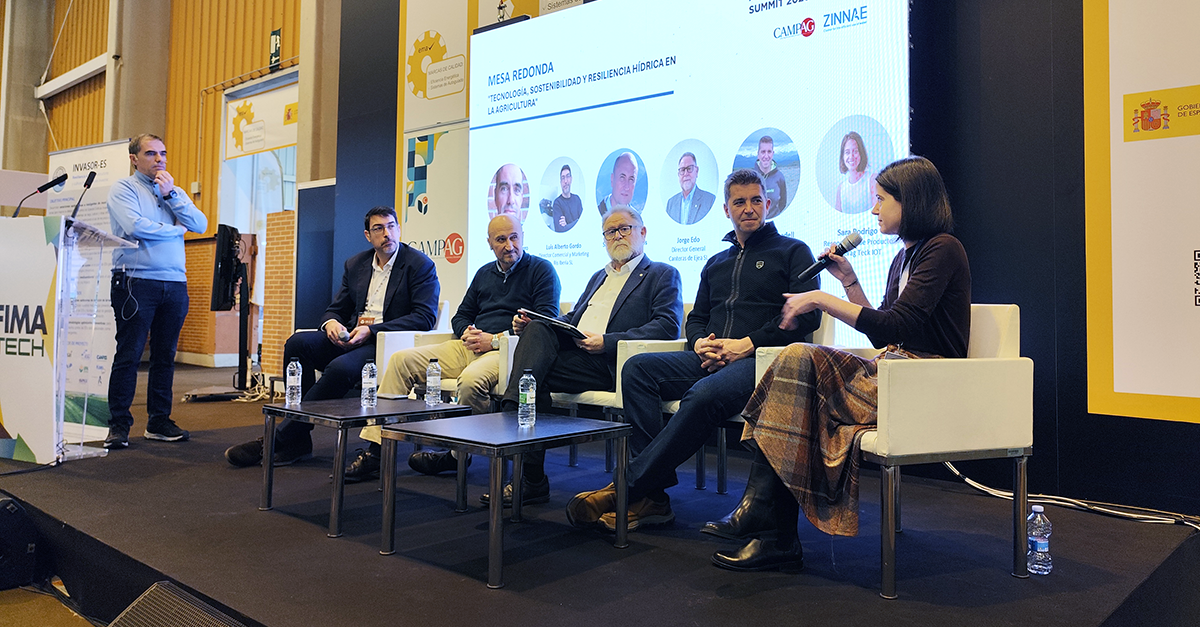
Within the unique setting of FIMA 2026, we took part in the conference “AGRO 5.0: Technology, sustainability and water resilience in the agriculture of the future”, organised by ZINNAE in collaboration with CAMPAG. A space to talk about innovation, yes, but above all about real-world application and tangible opportunities for the sector.
The event opened with three compelling use cases promoted by ZINNAE member companies, showing that digitalisation is already solving real challenges in the agri-food sector.
- Ricardo Forcadel, Technical Director at Mytruff, presented the Tecnotruf project, focusing on the digitalisation of truffle plantations, which are especially relevant in Teruel, where a large share of the world’s black truffle production is concentrated — 70%! Sensors and data to understand what is happening underground and improve crop management.
- Ángel Martínez, in turn, explained how the Invasor-ES project addresses 4.0 resilience against invasive species such as zebra mussels and apple snails. Through monitoring based on computer vision analysis, real-time data is obtained, enabling faster and more accurate action while minimising the use of biocides in hydraulic infrastructures.
- Ambvipur, presented by Cristina Benogechea, is working on the design of a digital solution for slurry application based on collective biosecurity criteria, using monitoring as a tool to optimise processes and meet regulatory requirements.
At SPHERAG we are very familiar with these challenges and we are also involved in projects that are part of the solution. Our technology already enables optimised water management in truffle farms and pig farms through the use of real-time data. In addition, together with the CSIC we are participating in the SimZebra project, focused on the early detection of zebra mussels in pressurised networks — a critical challenge for many irrigation communities.
Digitalisation is not theory: it is field, data and decision-making.
Round table: measure well to decide better
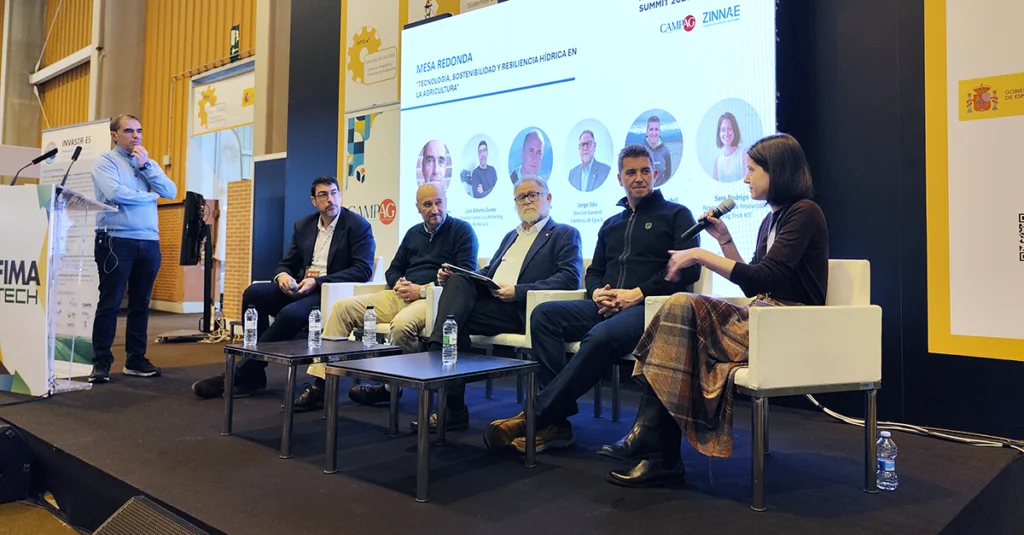
The round table, moderated by José Javier Peguero (CITA), brought together companies from the agrotechnology and water sector such as RIS Iberia, SM Geodim, Canteras de Ejea, Mytruff and Spherag, with our Head of Product, Sara Rodrigo, as a speaker.
Alongside her were Luis Alberto Gordo Martínez, Commercial and Marketing Director at RIS Iberia; Salomón Montesinos Aranda, CEO of SM Geodim; Jorge Edo Albácar, CEO of Canteras de Ejea; and Ricardo Forcadell Pérez, Technical Director at Mytruff.
Measuring, yes, but with a purpose
There was consensus around central message: there is endless technology and it is possible to measure almost everything, but not all users need so many features or such a high level of accuracy. Perhaps we do not need more screens or more metrics. We need clarity. Start with a project that define real objectives and, from there, choose the right technology.
Resistance and barriers to digitalisation were also discussed. In some cases, it has not been a rejection of technology, but a rejection of imposed solutions that were poorly adapted or economically unfeasible. However, when the technology is robust, simple and truly useful, the barrier disappears.
There was also agreement on another key point: it is not about telling farmers what they have to do, but about providing them with data-driven information so they can make their own decisions. Active listening, boots in the field, and the commercial team acting as a constant and fluid channel between the user and the technology company’s development team.
Water management in irrigation communities: the pending challenge
For years, a great effort has been made to digitalise the farm, but throughout the round table there was a shared feeling that an upstream subject is still pending: irrigation communities, main networks and delivery points. If we do not measure at the head of the system, it will be difficult to optimise the whole.
The technology is mature; now the focus must be placed on well-defined projects and strategic investment.
The Canal de Aragón y Cataluña, whose digitalisation has been awarded to SPHERAG and is currently under implementation, marks a turning point. It is one of the largest and most advanced irrigation communities in the world thanks to this digital transformation process. Projects of this scale confirm the growing interest in the sector in deploying more efficient systems that save water and make daily management easier, a momentum that is also being driven by public funding.